Toward an IoT Cyber-Infrastructure for Low-Cost Urban Air Quality Monitoring
Published in IEEE eScience 2019:


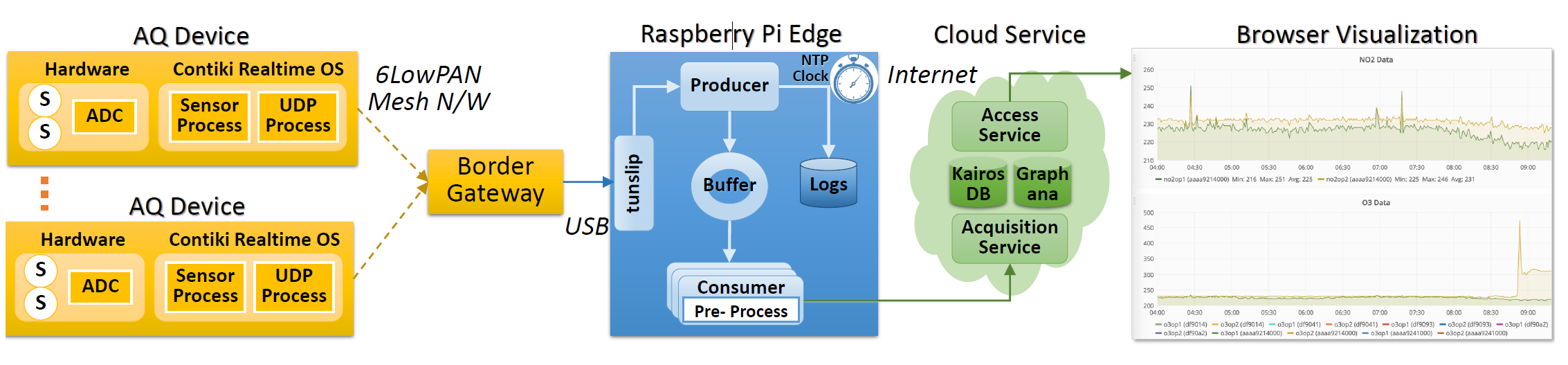
Urban air pollution remains a major global health concern, particularly in megacities like Delhi and Mumbai where the density of population and vehicles makes continuous air quality monitoring essential yet prohibitively expensive. SATVAM was conceived to bridge this gap — an interdisciplinary effort to design a city-scale network of affordable air quality sensors that can deliver high-resolution, real-time environmental data to citizens, scientists, and policymakers alike.
At the heart of SATVAM is a robust IoT cyber-infrastructure that connects low-cost sensing devices through a wireless mesh network to edge computing gateways and cloud-based analytics. This architecture enables resilient data collection even under unreliable connectivity and integrates calibration models that transform noisy, low-cost sensor readings into reliable scientific measurements. The project introduced lightweight statistical and machine learning models that correct for sensor inaccuracies in the field, reducing prediction errors from around 60% to as low as 20%.
Field deployments across Delhi and Mumbai validated SATVAM’s end-to-end system in real-world conditions. The results demonstrated that low-cost sensors, when paired with intelligent data processing and resilient infrastructure, can form the backbone of large-scale urban sensing networks. SATVAM lays the groundwork for democratizing environmental monitoring — transforming how cities observe, understand, and respond to air pollution.
Sponsors: IUSSTF, DST, Intel, Microsoft Research India, Microsoft Azure Grant