Robust Blind Image Denoising via Instance Normalization
Published as MS Thesis:

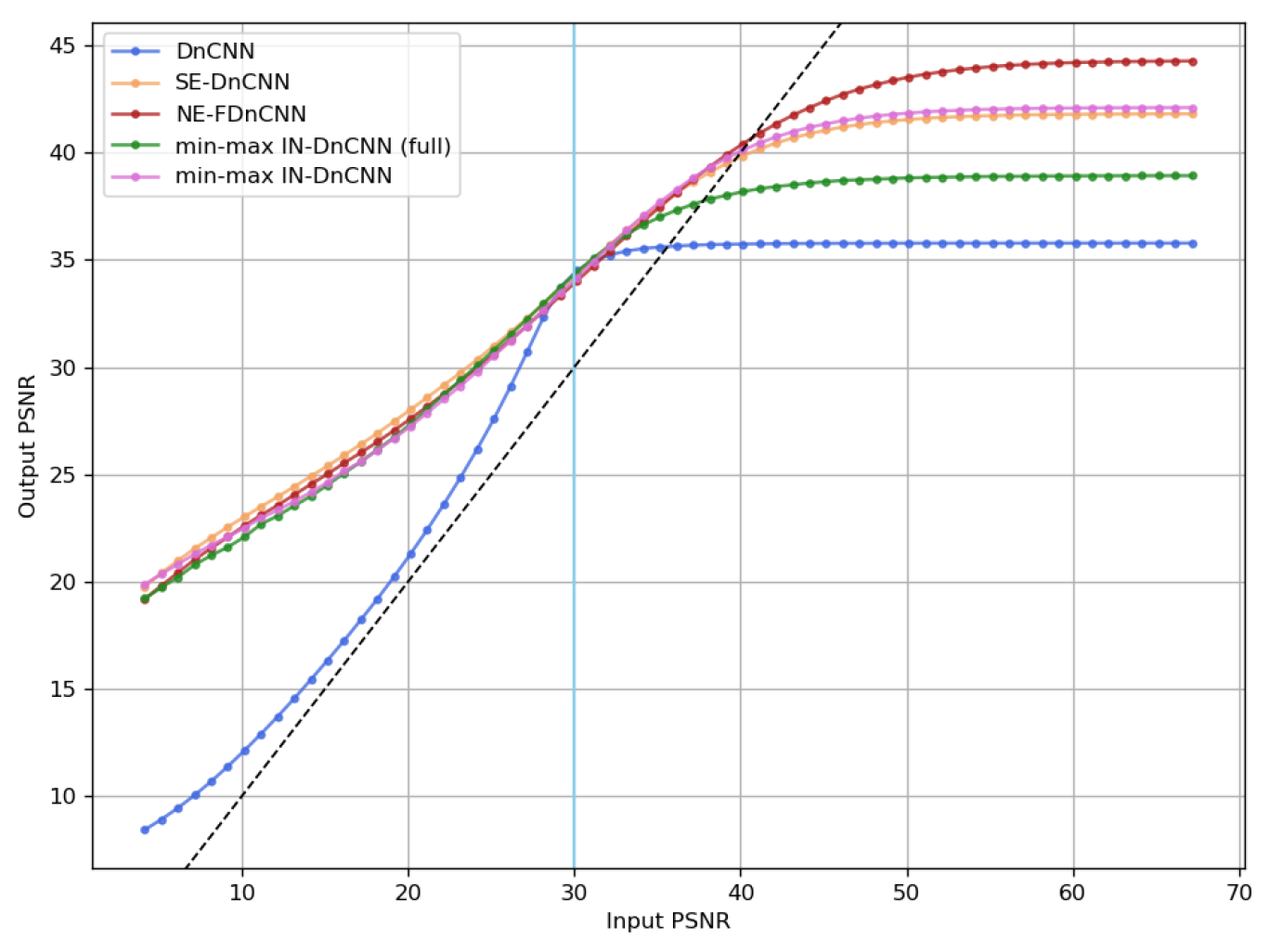
Image denoisers are a widely applicable tool in many image inverse problems like compressive sensing, deblurring, in-painting, super-resolution, etc. Various algorithmic approaches for denoising have been studied in the past decades. However, data-driven denoising methods, which learn to denoise images from large image datasets using deep neural networks, have demonstrated far superior performance compared to the classical algorithmic methods while having much faster inference times. While non-blind methods require knowledge of the noise level contained within the image, blind methods which require no such information are more practical. However, the performance of many recent state-of-the-art blind denoisers depend heavily on the noise levels used during training. In more recent work, ideas of inducing scale and normalization equivariance properties in denoisers have been explored in order to make denoisers more robust to changes in noise levels from training to test data.
In our work we extend upon this idea, where we introduce a method to make any given denoiser normalization equivariant using a simple idea of instance normalization, which improves the noise level robustness of the denoiser by a significantly large margin with minimal change to the underlying architecture. In this thesis, we theoretically formulate our idea from the perspective of minimizers of the Wasserstein-1 distance between empirical distributions of training and test data, and propose a more practically feasible 2-pixel approximation that yields a quantile-based instance normalization method which makes our proposed normalization more robust to outlier pixels in images. Our instance normalization method can be implemented as a straightforward extension of any denoising architecture, thus leveraging the inherent qualities of the underlying denoiser, without compromising on robustness and qualitative performance.